

Click here for our most recent e-newsletter, explaining why we like producing trail running events on western film sets and historic ranch sites.

Hello Run Tucson community. This past Saturday we produced the Empire Ranch Trail Run down at the historic Empire Ranch, established as a homestead ranch in the 1860’s. Next month we’ll produce another trail event, the TMC Old Tucson Trail Run on the grounds of Old Tucson Studios and the saguaro-studded desert trails near Gates Pass.
For this newsletter, we write about why we love producing races on these iconic lands.
| For us, it’s a privilege and a joy to produce running events here in Southern Arizona — the soaring sky, the desert, the cactus, the mountains. We’re mindful of the real history of these lands and we’re mindful of the myths of these lands, but there’s something about this land that catches the imagination . . . for better and for worse, these are iconic American spaces. This perhaps explains why the Empire Ranch and Old Tucson have been used so often as film sets. These lands are some of the most recognized western film locations in American cinematography. The Western is a fascinating genre of American storytelling, in part because the stories often try to create a simple (though perhaps naive) view of what is good and what is bad, what is right and what is wrong. Indeed, if you ever get a chance to watch old Westerns on Grit, Inspiration, TCM or the Western Channel, you’ll note that in most every film produced after World War Two and during the early stages of the Cold War it’s easy to see who the “good guy” is and who the “bad guy” is. When you watch a movie with Glenn Ford, Randolph Scott, or Jimmy Stewart (or television shows such as Gunsmoke, Wagon Train, Cheyenne), the so-called “good guys” are nice to people. They work hard. They help one another. They support and protect the weak. They stand their ground in the face of danger. The “good guys” may wrestle with internal demons, but they try to do the right thing. These stories also tell us what a “bad guy” is. We all know the white hat/black hat dichotomy and we all know the image of the masked man, with bad guys wearing bandanas or KKK-style sacks to hide their faces. Here’s a photo grabbed while we were watching a TV movie on Grit earlier this week — these bad guys in masks are just about where the start/finish line is for next month’s race. |
|
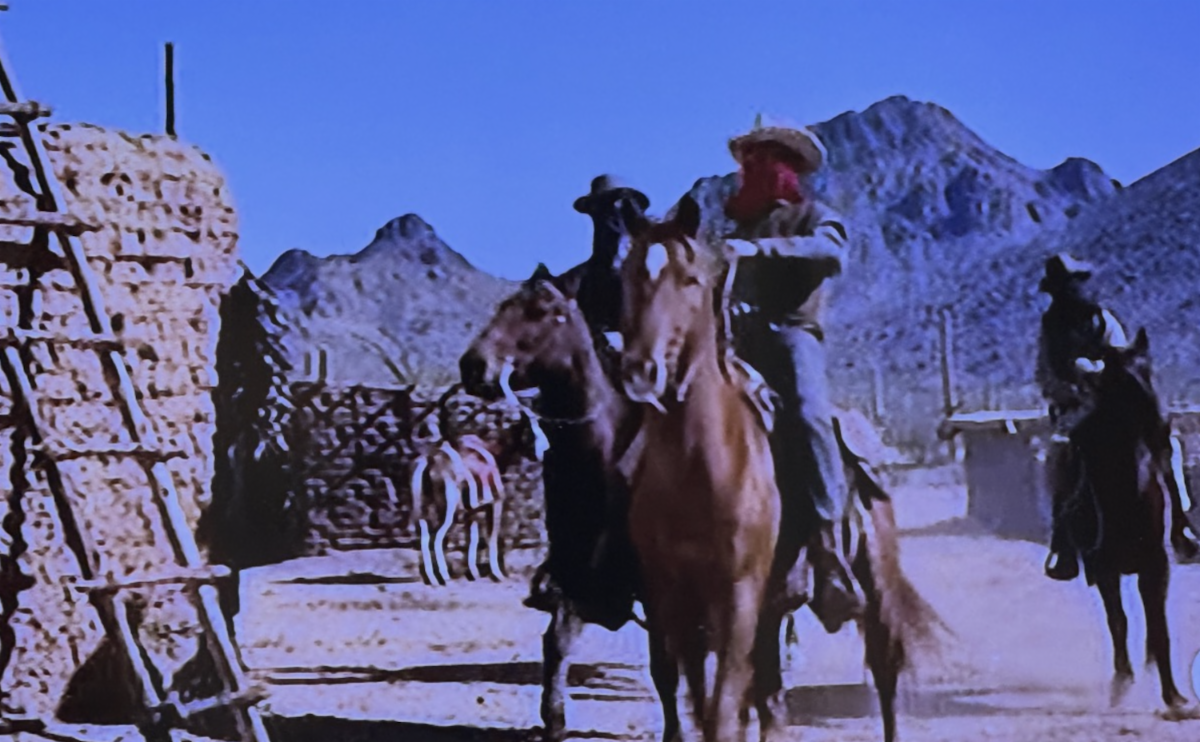
Coming out of World War Two, these films remind us that bad guys gang up on the innocent. They take land that they don’t own. They terrorize the innocent. They shoot people in the back. They’re corrupt, seeking money and power at all costs. Heck, the bad guys even shoot down pet dogs in movies like John Wayne’s Big Jake or Ethan Hawke’s In the Valley of Violence.
Now, as we mentioned, this is a somewhat naive view of the world, and by the late 50’s and mid-60’s, in response to the growing Civil Rights Movement and the Vietnam War, the Western became a way for America to wrestle with the legacy of imperialism, racism, sexism, and ethnic cleansing.
Think of The Wild Bunch, Little Big Man, and Soldier Blue. If you get a chance, check out 1959’s Last Train From Gun Hill, filmed in and around Empire Ranch and Old Tucson, where a woman driving a buggy is shot to death by bad guy hoodlums, who are then shielded by the power of the wealthy. Maybe who we thought were the good guys were actually not-so-good-guys, these films suggest.
(We’re using the terms “bad guys” and “good guys” but many stories flip the script — Bad Girls with Madeleine Stowe and Drew Barrymore come to mind, along with Mario Van Peebles’ Posse and the more recent Outlaw Johnny Black.)
Old Tucson Studios was ground zero for this new myth-making. Think of the cast and characters of the TV shows High Chaparral and The Young Riders: each are a melting pot of immigrant ethnicity, of interracial marriages, and even of gender identity (consider the Lou McLoud character in Young Riders, a woman dressing as a man in order to hold a job as a Pony Express rider).
These shows are part of our national story-telling. They are still on television for all of us to see that all kinds of people from all walks of life can come together to make individual lives better and make the bonds of community stronger.
The Western calls for you to choose a side — do you want to be the violent bully out for your own self-interest or do you want to work with others to make the land a better place?
We all know that real life isn’t as easy as a movie, but these sorts of films can remind us what it takes to live a life of grace, a life of kindness, of industry, of honor.
OK — thanks for indulging our film recap. As we said, we at Run Tucson are mindful of the history of these lands that we run upon and we’re mindful of the many stories that are told about these lands.
And, as always, we’re grateful to those who join us in treasuring these spaces. Perhaps we’ll see you at the races!